



You’ll torch the most calories with HIIT workouts that spike your metabolism for 24-48 hours post-exercise, burning 25-30% more than steady cardio. Swimming activates 86% of your muscles while burning 400-700 calories hourly, and rowing engages similar muscle mass at 600-800 calories per hour. Jump rope delivers 10-16 calories per minute, while battle ropes and kettlebell swings create powerful metabolic conditioning. The science behind each method’s unique fat-burning mechanisms will transform your workout strategy.
Key Takeaways
- HIIT burns 25-30% more calories than steady-state cardio and elevates metabolism for 24-48 hours post-workout.
- Swimming burns 400-700 calories per hour while engaging every major muscle group with joint-protecting water resistance.
- Rowing burns 600-800 calories per hour using 86% of muscle mass, exceeding running by 15% at moderate intensity.
- Kettlebell swings burn 20 calories per minute through rapid-fire hip hinges that strengthen the entire posterior chain.
- Combining battle ropes with kettlebell swings creates maximum metabolic impact through alternating high-intensity intervals and strength movements.
High-Intensity Interval Training (HIIT): The Metabolic Powerhouse
When you’re looking to maximize fat burn in minimal time, HIIT delivers unmatched results through its unique metabolic effects. You’ll torch calories during and after workouts through excess post-exercise oxygen consumption (EPOC). Research shows HIIT benefits extend beyond weight loss—you’ll improve cardiovascular health and insulin sensitivity.
Your ideal HIIT duration ranges from 15-30 minutes, with work-to-rest ratios of 1:1 or 2:1. You’ll achieve best results with HIIT frequency of 2-3 sessions weekly, allowing adequate HIIT recovery between workouts. Try HIIT variations like sprints, burpees, or cycling intervals to prevent adaptation.
Don’t fall for HIIT misconceptions—more isn’t better. You can’t perform true HIIT daily without compromising intensity or risking overtraining. Focus on quality over quantity for sustainable fat-burning success.
Running vs. Walking: Breaking Down the Calorie Burn Debate
How much difference does your pace really make when you’re trying to burn fat? The calorie comparison reveals striking differences: running burns approximately 100 calories per mile for a 155-pound person, while walking burns about 65 calories. Nevertheless, exercise efficiency isn’t just about raw numbers.
Running torches calories faster—you’ll burn 300 calories in 30 minutes at a 6 mph pace. Walking the same duration at 3.5 mph burns only 150 calories. But here’s what matters: walking’s lower impact means you can sustain it longer and recover faster, potentially leading to greater weekly calorie expenditure.
Your fitness level, joint health, and consistency determine the winner. If you can’t run regularly due to injury risk, walking’s sustainability trumps running’s intensity for long-term fat loss.
Rowing: The Full-Body Fat Torcher You’re Probably Ignoring
The rowing machine sits empty in most gyms while treadmills stay packed—yet it’s crushing both running and cycling for total calorie burn. You’re torching 600-800 calories per hour while involving 86% of your muscle mass. That’s nine major muscle groups firing simultaneously.
Your rowing benefits extend beyond fat loss. You’re building cardiovascular endurance while strengthening your back, legs, and core without joint impact. Proper rowing techniques enhance results: drive through your legs first (60% power), lean back slightly (20% power), then pull arms to chest (20% power). Reverse the sequence smoothly.
You’ll burn 15% more calories than running at moderate intensity. Plus, the afterburn effect keeps your metabolism heightened for hours post-workout. Time to claim that empty rower.
Jump Rope: Why Boxers Swear by This Simple Tool
While elite boxers dedicate 20-30 minutes daily to jump rope training, you’re missing out on one of the most efficient fat-burning exercises available. You’ll torch 10-16 calories per minute while improving coordination, agility, and cardiovascular endurance simultaneously.
Master basic jump rope techniques first: two-foot jumps, alternating feet, and single-leg hops. Once you’ve built rhythm, advance to double-unders and criss-cross patterns for increased intensity. The fitness benefits extend beyond calorie burn—you’ll strengthen calves, shoulders, and core while boosting bone density.
Start with 30-second intervals, resting 30 seconds between sets. Progress to 3-minute rounds mimicking boxing training. You don’t need expensive equipment; a basic rope costs under $20. Within weeks, you’ll understand why professional fighters consider this tool indispensable for conditioning.
Swimming: Low-Impact Doesn’t Mean Low Results
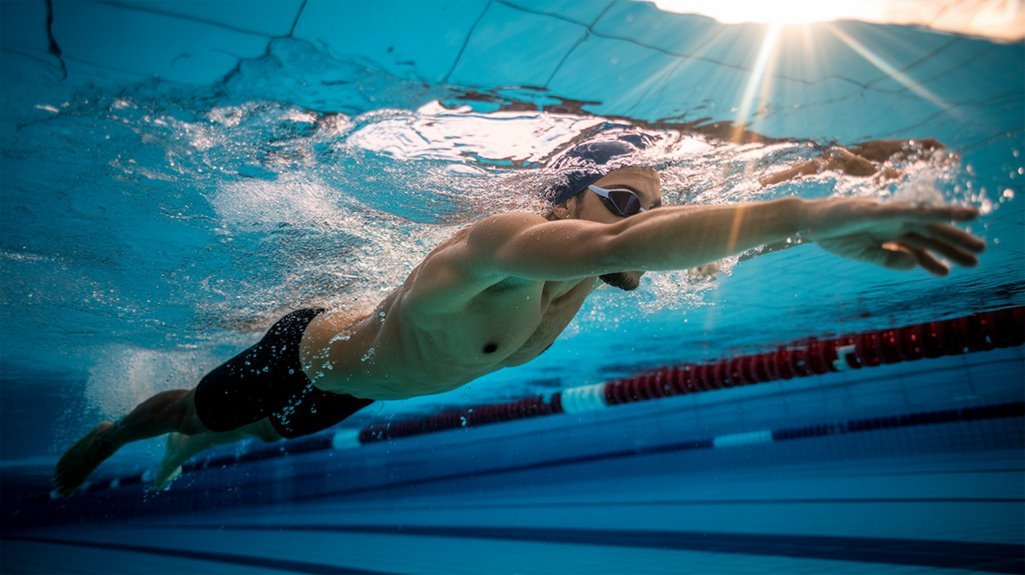
You’ll activate nearly every major muscle group when you swim, from your shoulders and core to your glutes and calves, creating a metabolic furnace that torches calories long after you’ve dried off. Research shows you can burn 400-700 calories per hour depending on your stroke choice and intensity, matching or exceeding many high-impact exercises. The water’s resistance provides constant tension against your movements, forcing your muscles to work harder while protecting your joints from the stress that comes with pounding pavement.
Full Body Muscle Engagement
Swimming activates nearly every major muscle group in your body simultaneously, making it one of the most thorough fat-burning exercises available. Your legs drive powerful kicks while your arms pull through the water, captivating deltoids, lats, and triceps. Your core works overtime to maintain proper body position and streamline.
This full body recruitment creates massive caloric expenditure. You’ll torch 400-700 calories per hour depending on stroke intensity and efficiency. Unlike isolated exercises, swimming forces multiple muscle groups to fire together, elevating your metabolic rate for hours post-workout. The resistance from water provides constant tension, building lean muscle while stripping fat. You’re fundamentally performing hundreds of repetitions against resistance, transforming your physique through thorough muscular involvement.
Calorie Burn Per Hour
The numbers speak for themselves when measuring swimming’s fat-burning potential. You’ll torch 400-700 calories per hour depending on your stroke choice and exercise intensity. Butterfly leads the pack at 700 calories/hour, while backstroke burns approximately 400. Your caloric deficit increases considerably when you maintain a vigorous pace versus leisurely laps.
Swimming’s water resistance enhances energy expenditure—you’re working against a force 800 times denser than air. This means every movement demands more effort, accelerating your metabolic rate. You’ll burn 30% more calories swimming than running at comparable intensities. The continuous motion required to stay afloat guarantees no rest periods, keeping your heart rate raised throughout. Temperature regulation in cool water adds another 10-15% to your total calorie burn, making swimming exceptionally efficient for fat loss.
Cycling and Spin Classes: Pedaling Your Way to Fat Loss
You’ll burn approximately 400-600 calories per hour cycling outdoors at moderate intensity, while indoor spin classes can torch up to 800 calories through structured HIIT protocols. Both options trigger excess post-exercise oxygen consumption (EPOC), keeping your metabolism boosted for hours after you’ve stopped pedaling. Whether you’re conquering hills on scenic routes or crushing intervals in a dark studio, cycling’s variable resistance and sustained cardiovascular demand make it one of the most efficient fat-burning exercises available.
Outdoor Vs Indoor Cycling
While both outdoor and indoor cycling torch calories and melt body fat, each option offers distinct advantages that can maximize your fat-burning potential. Outdoor benefits include varied terrain that naturally creates interval training, forcing your muscles to adapt constantly. You’ll engage more stabilizer muscles traversing real-world conditions, burning 15-20% more calories than stationary cycling.
Indoor convenience shines through controlled environments and structured workouts. You’ll maintain consistent intensity without weather interruptions, traffic, or safety concerns. Spin classes provide motivating music and expert coaching that push you beyond comfort zones. Research shows high-intensity indoor cycling sessions can achieve 600-800 calories burned per hour.
Choose outdoor cycling for functional fitness and mental stimulation. Select indoor options when you need reliable, time-efficient workouts that deliver measurable results.
High Intensity Interval Training
When you incorporate high-intensity interval training (HIIT) into your cycling routine, you’re activating one of the most powerful fat-burning mechanisms available. HIIT’s interval structure alternates between maximum effort bursts and strategic recovery periods, triggering excess post-exercise oxygen consumption (EPOC).
You’ll maximize results by following these proven protocols:
- 30-second sprints: Push 85-95% maximum heart rate, followed by 90-second active recovery
- Tabata intervals: Execute 20 seconds all-out effort with 10 seconds rest, repeated 8 times
- Pyramid training: Build from 30 to 120-second intervals, then descend back down
Research shows HIIT burns 25-30% more calories than steady-state cardio. You’re not just torching fat during workouts—your metabolic rate stays heightened for 24-48 hours post-session. This afterburn effect makes HIIT your secret weapon for efficient fat loss.
Stair Climbing: The Vertical Challenge That Delivers

Stair climbing torches calories at an impressive rate of 8-11 calories per minute, making it one of the most efficient cardiovascular exercises you can perform without equipment. You’ll engage your glutes, quadriceps, hamstrings, and calves while elevating your heart rate to 65-85% of maximum capacity.
The stair climbing benefits extend beyond calorie burn. You’re strengthening your lower body, improving bone density, and boosting cardiovascular endurance simultaneously. Research shows you’ll burn 50% more calories than walking on flat ground.
Master proper stair climbing techniques: maintain upright posture, push through your heels, and avoid leaning forward. You can vary intensity by taking two steps at once, adding lateral movements, or increasing speed. Start with 10-minute sessions and progressively build to 20-30 minutes for ideal fat-burning results.
Battle Ropes and Kettlebell Swings: Cardio Meets Strength
Although battle ropes and kettlebell swings target different muscle groups, they share a powerful characteristic: both exercises deliver exceptional metabolic conditioning while building functional strength. You’ll torch calories while developing explosive power through these energetic movements.
Battle ropes engage your entire upper body, creating waves that challenge:
- Core stability and rotational strength
- Shoulder endurance and grip power
- Cardiovascular capacity through sustained effort
Kettlebell swings complement this perfectly by emphasizing hip-hinge mechanics and posterior chain activation. You’re fundamentally performing rapid-fire deadlifts, burning 20 calories per minute while strengthening glutes and hamstrings.
Research shows both exercises enhance EPOC (excess post-exercise oxygen consumption), meaning you’ll continue burning calories hours after training. Alternate between 30-second battle rope intervals and 20 kettlebell swings for maximum metabolic impact.
Frequently Asked Questions
How Long Should I Wait to Eat After Cardio for Optimal Fat Burning?
You’ll maximize fat burning by waiting 30-60 minutes post cardio nutrition. This meal timing strategy lets your body continue using fat stores. Nevertheless, don’t wait too long – you’ll need protein and carbs for recovery.
Can I Do Cardio Exercises if I Have Bad Knees or Joint Problems?
Yes, you can! Try low impact options like swimming, cycling, or elliptical training. These joint friendly activities protect your knees while maintaining cardiovascular benefits. Water-based exercises particularly reduce stress by 90% through buoyancy support.
What’s the Best Time of Day to Do Cardio for Maximum Fat Loss?
You’ll maximize fat-burning doing fasted morning cardio when cortisol’s raised and insulin’s low. Nevertheless, if morning motivation’s lacking, evening energy works too—consistency trumps timing. Research shows 24-hour calorie deficit matters most for sustainable results.
Should I Do Cardio Before or After Weight Training for Better Results?
Research shows post workout cardio preserves more strength gains while pre workout cardio may reduce lifting performance. You’ll maximize muscle retention and fat loss by lifting first, then doing cardio. Both work—consistency matters most!
How Many Rest Days Should I Take Between Intense Cardio Sessions?
You’ll need 1-2 rest days between intense cardio sessions for ideal cardio recovery. Rest day importance can’t be overstated—your muscles rebuild stronger during recovery. Listen to your body’s signals and adjust accordingly for sustainable progress.
Conclusion
You’ve discovered the science behind fat-burning cardio, from HIIT’s metabolic boost to swimming’s joint-friendly efficiency. Research confirms that varying intensity and incorporating full-body movements maximizes caloric expenditure and EPOC (excess post-exercise oxygen consumption). Don’t settle for one method—rotate between these proven exercises to prevent adaptation and maintain progressive overload. Track your heart rate zones, measure your progress, and commit to consistency. Your body’s transformation depends on the effort you’re willing to invest starting today.